KFUPM DeepTech Venture TRL 5

Cure composites in minutes, not days.

We replace the autoclave with adaptive electromagnetic induction — heating the resin from inside the laminate, and holding the cure profile uniform across the whole part.

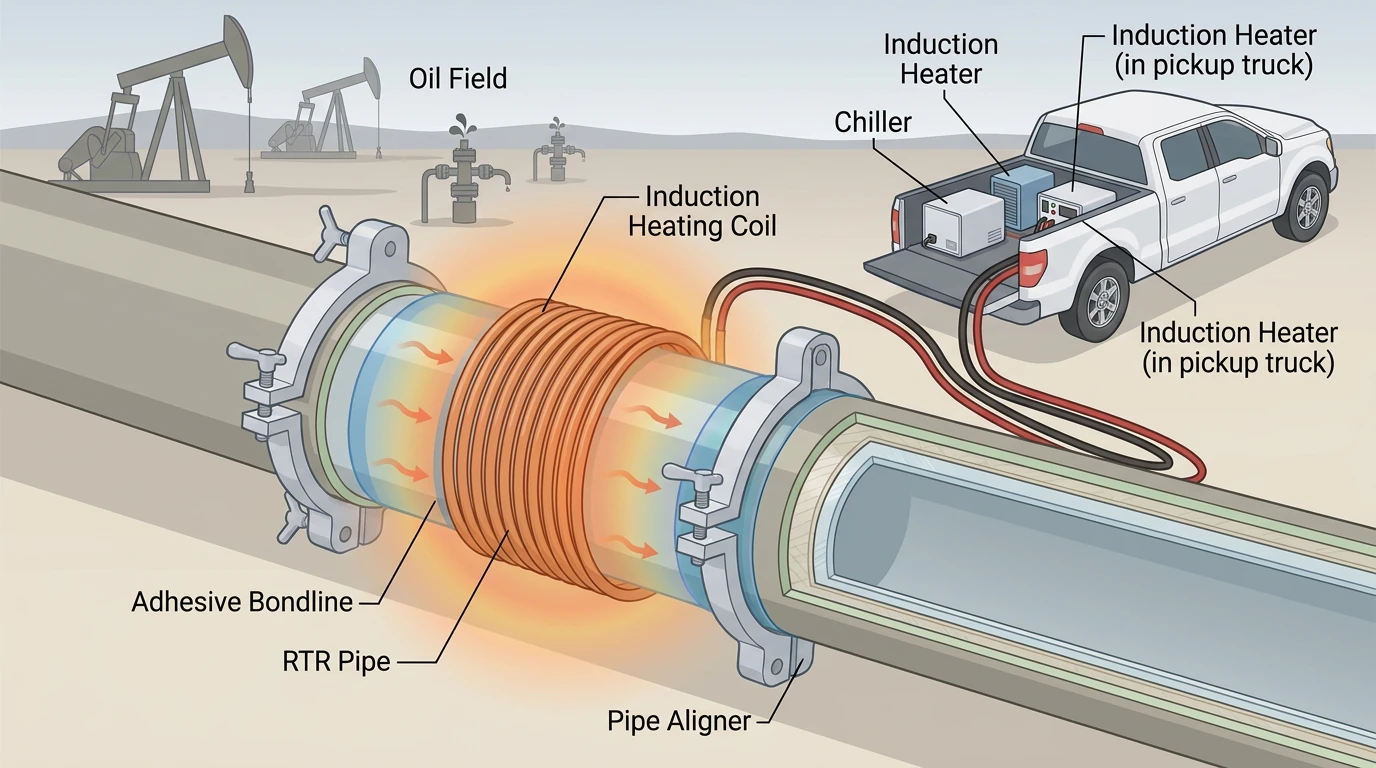
Field joining of reinforced thermoplastic pipe: an induction heating coil wrapped around the joint between two pipe aligner clamps melts the adhesive bondline, while a chiller and induction heater run from a pickup truck against an oil-field backdrop.
Fig. 01 — Field induction joining of RTR pipe 48 h < 10 min
< 10 min Typical cure cycle
Up to 90% Less energy used
TRL 5 Validated in lab
Built for
  • Aerospace & defence
  • Oil & gas
  • Automotive
  • Renewable energy
  • Industrial & construction
  • Composite pressure vessels
  • Non-metallic pipe
  • Backed by KFUPM DeepTech Venture Program
  • Intellectual property Patents filed on adaptive & multi-zone curing
  • Partners Add Composites · Innotech Photonics

The bottleneck

Curing is where composite production loses its time.

The material science moved on decades ago. The oven did not. Everything downstream of layup still waits on a thermal cycle designed around heating a room, not a part.

Conventional

Heat the chamber, wait, repeat.

Autoclaves and thermal ovens raise the temperature of an entire pressure vessel to cure a component that may occupy a fraction of it. A single cycle can run up to 48 hours.

The consequences compound: throughput is capped by oven availability, energy cost scales with chamber volume rather than part volume, and adding capacity means adding capital equipment and floor space before a single extra part ships.

4NMx

Heat the part, measure it, correct it.

An alternating electromagnetic field couples directly into magnetic nanoparticles dispersed through the resin. Heat is generated inside the laminate itself, so nothing is spent warming air, tooling, or steel.

Because the cure is instrumented rather than assumed, the system can respond to what the material is actually doing — holding a uniform profile across varying thickness and geometry instead of running a fixed recipe and hoping.

How it works

Three subsystems, one closed loop.

Induction supplies the energy, sensing describes the state of the resin, and the control model reconciles the two — continuously, for the duration of the cycle.

01 / Induce

Localised induction heating

An electromagnetic field is applied to resin-infused laminate containing magnetic nanoparticles. The particles dissipate energy as heat exactly where the resin needs it, with no thermal mass to bring up to temperature first.
02 / Sense

Real-time process measurement

Embedded sensors track temperature, magnetic field strength and resin viscosity throughout the cycle, so the degree of cure is observed directly rather than inferred from elapsed time.

03 / Adapt

AI-based adaptive control

The control model adjusts power and frequency as the cure progresses, compensating for thickness, geometry and local variation to keep the profile uniform from edge to edge.

01 02 03 Induce Sense Adapt ELECTROMAGNETIC FIELD TEMP · FIELD · VISCOSITY POWER · FREQUENCY CORRECTION APPLIED CONTINUOUSLY THROUGH THE CYCLE

Advantages

What changes on the shop floor.

The point is not a faster oven. It is removing the oven from the critical path so that cure time stops governing how much a line can produce.

Order-of-magnitude faster cycles

Cure times measured in minutes rather than hours release the throughput currently locked up waiting for oven capacity.

Up to 90% less energy

Energy goes into the laminate instead of the chamber, cutting both operating cost and the emissions attached to every part.

Consistency you can evidence

Every cycle is instrumented, so cure quality is recorded as process data rather than assumed from a fixed schedule.

Modular retrofit

Designed to sit inside an existing line and scale by adding zones — no pressure vessel, no new building.

Lower-emission process

Replacing autoclave cycles with localised curing removes one of the most carbon-intensive steps in composite production.

Supports localisation

Lower capital intensity makes domestic advanced-materials manufacturing viable at smaller volumes.

Side by side

Against a conventional autoclave line.

Target performance for the 4NMx system, set against the thermal-oven and autoclave processes it is designed to replace.

Parameter Autoclave / thermal oven 4NMx induction curing
Cure cycle Up to 48 hoursRamp, dwell and cool-down of the full chamber Under 10 minutesEnergy coupled directly into the resin system
Energy demand HighProportional to chamber volume, not part volume Up to 90% lowerHeating is localised to the laminate
Process control Open loopFixed recipe, cure inferred from elapsed time Closed loopSensor feedback with continuous correction
Capital & footprint SubstantialPressure vessel, services and dedicated floor space MinimalModular cell integrated into the existing line
Scaling capacity Step changeAnother autoclave, or nothing IncrementalAdd zones or cells as demand grows
Emissions per part HighLong cycles on a large thermal load LowShort cycles, minimal wasted heat

Scroll the table sideways to compare →

Applications

Wherever thermoset composites are cured.

The process suits epoxy, polyester and vinyl ester systems reinforced with carbon or glass fibre — the material families behind most structural non-metallic parts.

Aerospace & defence

Structural components where cure consistency is a qualification requirement, not a preference.

Oil & gas

Non-metallic pipe, spoolable line and corrosion-resistant equipment produced at length.

Automotive

Lightweight body and chassis parts at the cycle times volume production actually demands.

Renewable energy

Wind blade shells and spar caps, solar mounting structures, and filament-wound pressure vessels for hydrogen storage.

Industrial & construction

Storage tanks, cladding panels, composite rebar and pultruded structural profiles for corrosive environments.

Another application?

If the part is a thermoset composite, the process is worth assessing. Send the geometry and your current cure schedule.

Discuss a part

Capabilities & partners

Non-metallics, end to end.

Induction is our own technology. Around it we work with specialist partners across the rest of the chain, so a non-metallic structure can be built, joined in the field and inspected in service without the process being handed between vendors who have never spoken.

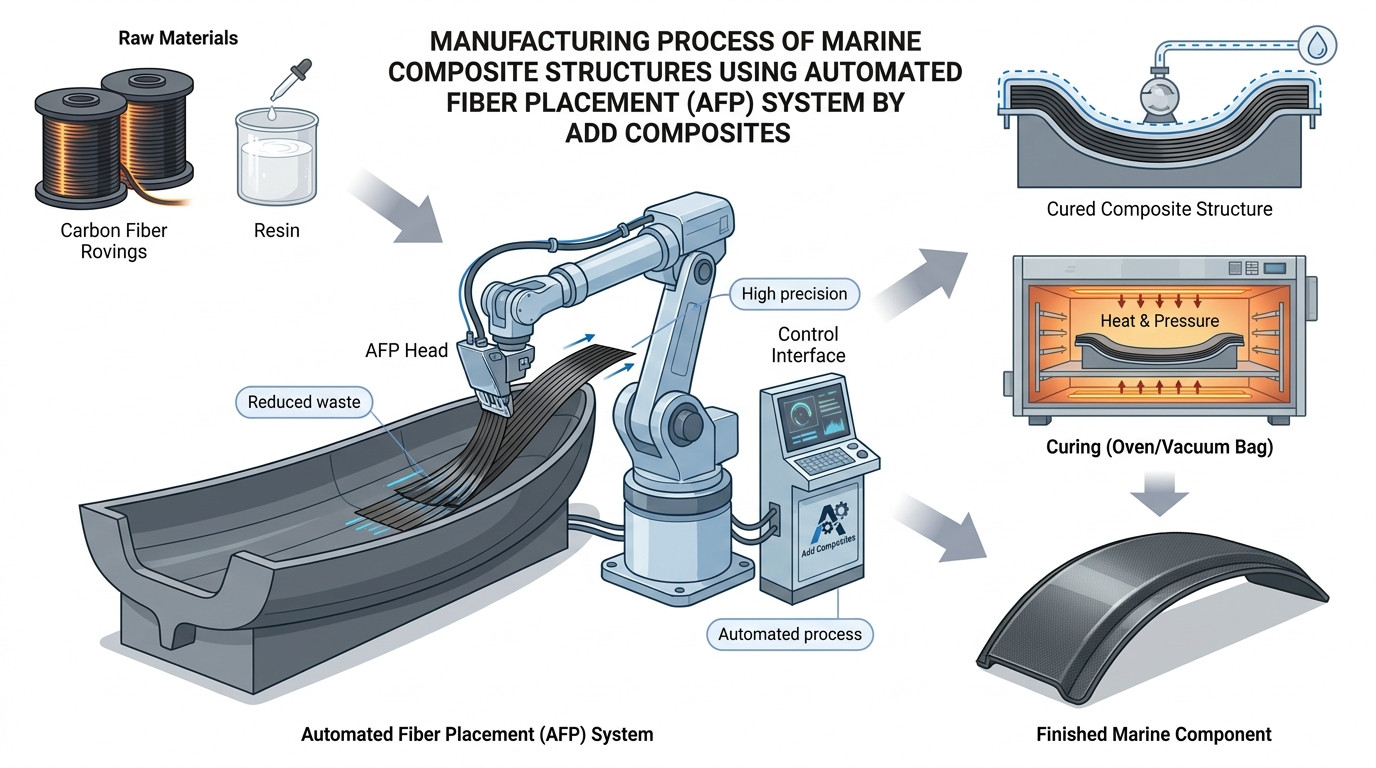
Process diagram: carbon fibre rovings and resin feed a robotic automated fibre placement head laying a marine hull form, followed by oven and vacuum-bag curing, producing a finished composite component. View full size
01 / Manufacturing

Automated fibre placement

Carbon rovings laid to shape by robot, with a precision and material yield hand layup cannot reach. What follows is the oven or vacuum-bag cure — the step that decides how fast the line can run, and the step our system replaces.

Partner — Add Composites

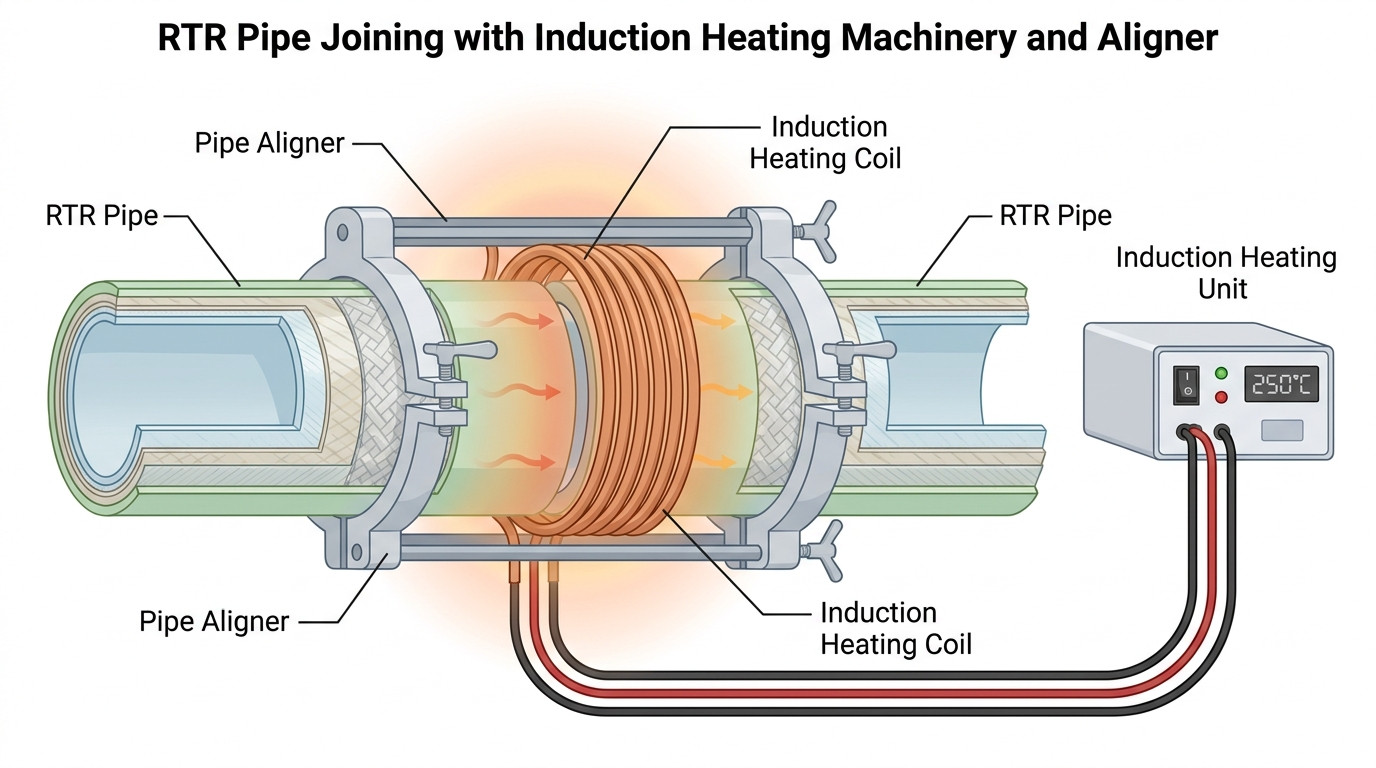
Cutaway diagram: two reinforced thermosetting resin pipe sections held by aligners, with an induction heating coil wrapped around the joint and a heating unit supplying it at 250 degrees Celsius. View full size
02 / Joining

Induction joining in the field

The same coupling principle as the curing cell, applied to reinforced thermosetting resin pipe. A coil and aligner bring the joint itself up to temperature — no furnace, no open flame, and the bond made where the pipe is laid rather than back at a shop.

4NMx technology

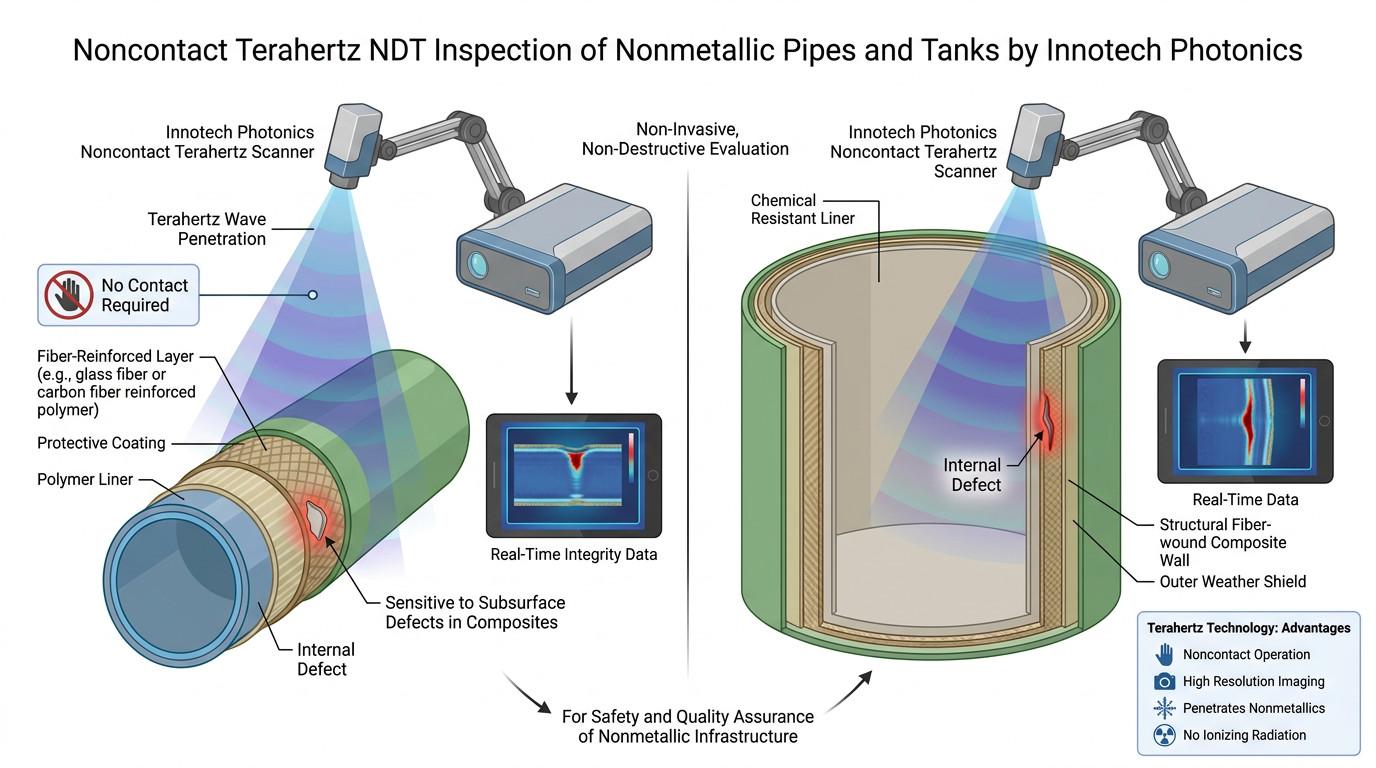
Diagram: a robot-mounted non-contact terahertz scanner imaging a layered composite pipe wall and a storage tank wall, with subsurface defects shown on real-time readout screens. View full size
03 / Inspection

Non-contact terahertz NDT

Terahertz scanning reads subsurface defects through composite pipe and tank walls with no contact, no couplant and no ionising radiation — integrity data on assets where contact methods are impractical.

Partner — Innotech Photonics

Got a curing bottleneck?

Send the part family, the resin system and your current cycle time. We will tell you whether induction curing is a fit — and say so plainly if it is not.

By the numbers

Where the technology stands today.

10× Faster, at minimum Cycle-time reduction demonstrated against conventional thermal curing.
90% Energy reduction target Upper bound modelled against equivalent autoclave cycles.
TRL 5 Readiness level Proof of concept validated under controlled laboratory conditions.
5+ Target sectors Aerospace, oil & gas, automotive, renewables and construction.

Research & development

An engineering programme, not a concept.

4NMx is developed inside the King Fahd University of Petroleum & Minerals research environment and supported by the KFUPM DeepTech Venture Program, with intellectual property filed around adaptive and multi-zone curing.

TRL 1–2

Principle established

Induction coupling into nanoparticle-loaded resin systems formulated and characterised.

TRL 5 — current

Validated in the lab

Working prototype demonstrating closed-loop adaptive curing under controlled conditions.

TRL 4–5

Pilot in a real environment

Multi-zone cell tested on representative parts with an industrial partner.

TRL 6+

Production integration

Line-integrated system qualified for continuous manufacturing use.

Team

Materials, electromagnetics, control.

A small founding team covering the three disciplines the system depends on — and the electronics that hold them together.

Dr. Suhail Hyder Vattathurvalappil

Dr. Suhail Hyder Vattathurvalappil

Founder & CEO

Leads the technical direction of the curing system and the venture's route to industry.

Mohammed Aves

Mohammed Aves

Co-founder & CTO

Co-inventor of the curing system. Leads electromagnetic design and the adaptive control architecture.

Dr. Irfan Alam

Dr. Irfan Alam

Co-founder & COO

Runs operations and delivery, and the machine learning behind real-time process optimisation.

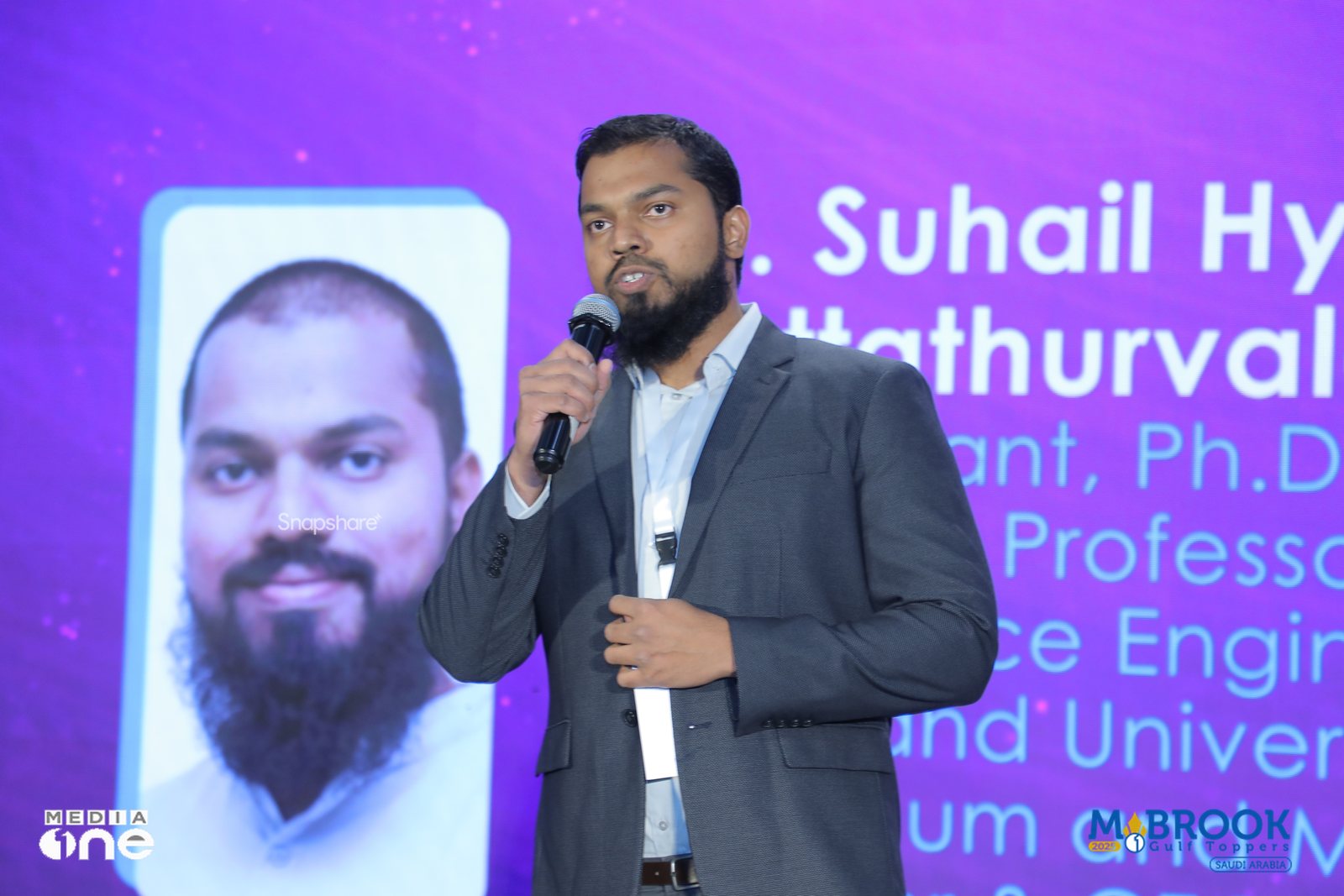
Dr. Suhail Hyder Vattathurvalappil presenting on stage at the Mabrook Gulf Toppers event in Saudi Arabia
Dr. Suhail Hyder Vattathurvalappil · Mabrook Gulf Toppers, Saudi Arabia

Outreach

Taking non-metallics to the people who build with them.

Advanced materials only get adopted when the engineers specifying them understand what has changed. We speak at industry and research events across the Gulf about where induction curing fits into composite production.

If you are organising a technical session, a supplier day or an innovation programme, we are happy to take part.

Invite us to speak

Questions

Before you get in touch.

The things manufacturers, researchers and investors ask us first. Anything not covered here, just send it over.

Thermoset systems — epoxy, polyester and vinyl ester resins — reinforced with carbon or glass fibre. The resin is loaded with magnetic nanoparticles so that the electromagnetic field can couple into the laminate directly. Suitability for a specific layup and resin system is something we assess as part of a pilot.

Embedded sensors report temperature, magnetic field strength and resin viscosity while the cure is running. The control model uses those readings to adjust power and frequency as it goes, which is what allows a uniform cure across changing thickness and geometry rather than hot spots at the edges. Because the cycle is measured rather than assumed, each part carries a process record.

TRL 5. The concept has been validated with a working prototype under controlled laboratory conditions. We are now working toward TRL 4–5, which means demonstrating a multi-zone cell on representative parts in an industrial setting. 4NMx is supported by the KFUPM DeepTech Venture Program.

That is the design intent. The system is modular and does not require a pressure vessel or dedicated building services, so it is meant to sit within an existing workflow and either complement or replace oven capacity. Integration detail depends on part size, geometry and takt time, which we work through during pilot scoping.

Two places. First, energy is delivered into the resin rather than into air, tooling and the steel shell of a chamber, so far less of it is wasted. Second, the cycle itself is far shorter, so there is less time for losses to accumulate. Our target of up to 90% is modelled against equivalent autoclave cycles and will be confirmed against measured pilot data.

We are looking for manufacturers with a real curing bottleneck, research partners in materials and process control, and investors backing deeptech at this stage. A pilot normally starts with a scoping conversation about your part family and current cycle, followed by lab-scale trials on your material before anything is built. Send us a note and we will set up the first call.

Contact

Tell us about your curing bottleneck.

Send the part family, the resin system and your current cycle time. We will come back with whether induction curing is a fit — and say so plainly if it is not.

suhail@4nmgroup.com 4NMx on LinkedIn
KFUPM, Dhahran, Saudi Arabia

We reply to technical enquiries within one working day.