Oil and gas
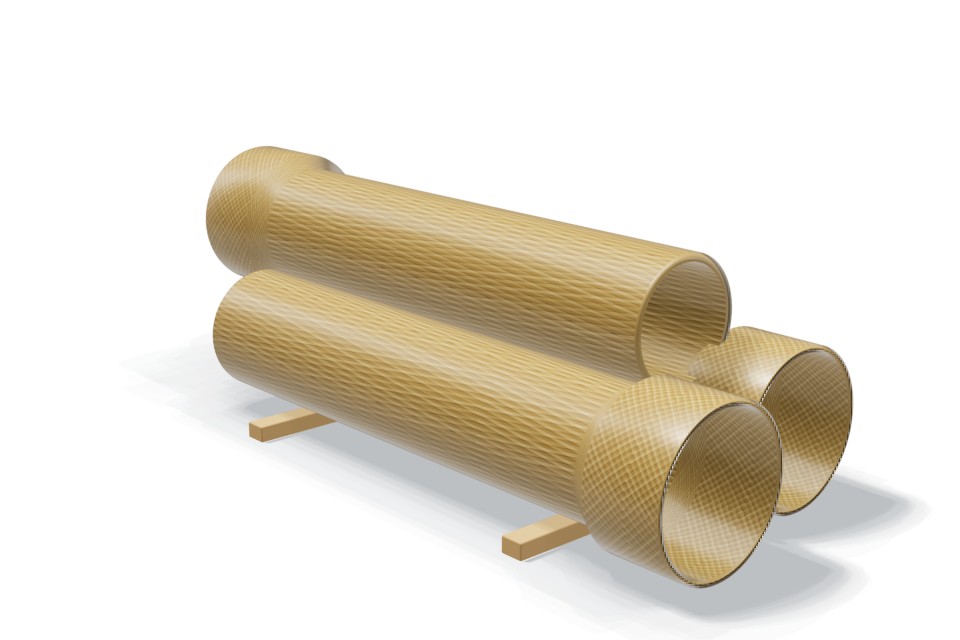
Non-metallic pipe, spoolable line and corrosion-resistant equipment, and the joints between them.
RTR pipe · spoolable line · field joints
 Get in touch
Induction curing for thermoset composites
Induction heats a nanoparticle-loaded resin from inside the laminate. Closed-loop control keeps the cure uniform.
A KFUPM DeepTech venture
Developed in Dhahran, Saudi Arabia
Adaptive inductionIllustrative equipment

Heat starts in the core of the laminate, not in the air around it.
The bottleneck
An autoclave heats a whole chamber to cure a part that may fill a fraction of it. Heat soaks in slowly from the surface, so cycle time and energy scale with the chamber, not the part.
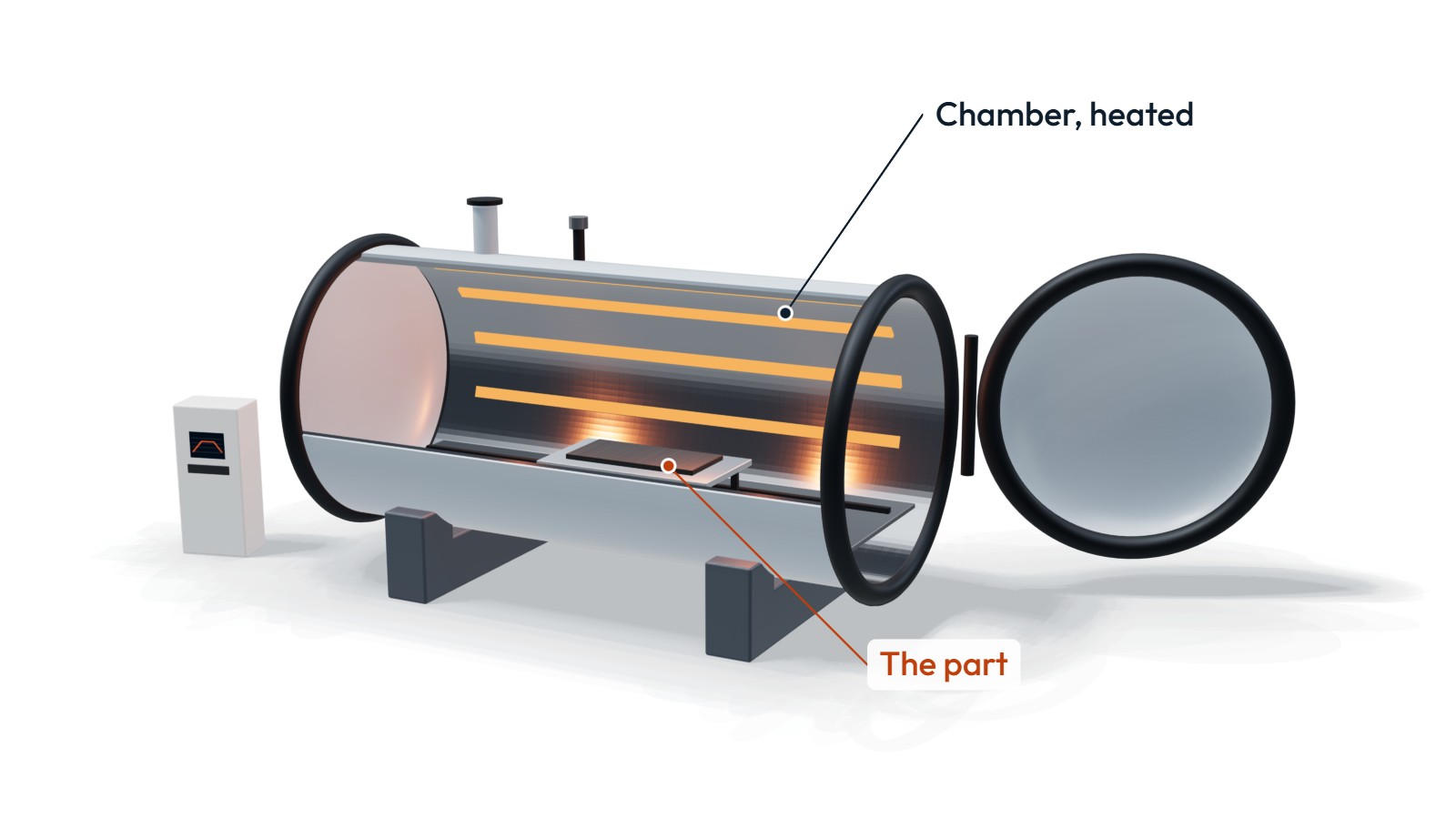
Conventional autoclave · reference
up to 48 hours
Upper end of a full cycle: ramp, dwell and cool-down.
4NMx induction · target
under 10 minutes
Target for the heat-and-cure stage. What is demonstrated so far
Illustrated time 10:00 / 10:00
Autoclave
Hot air heats the part from the outside in.
4NMx induction
Heat is generated inside the part.
Same ten minutes. One part has finished its target cycle; the other is still warming at the surface.
AmbientCure set-point
Fig. 3Illustrative animation, not measured data or a cure simulation. Induction follows the target cycle (under 10 minutes); the autoclave follows an air ramp of about 3 °C per minute. Surface and centre show the rise from ambient (0%) to the cure set-point (100%).
How it works
Induction supplies the energy, sensors report what the laminate is doing, and a control model corrects the input throughout.
A field is applied to a laminate whose resin carries magnetic nanoparticles. They release heat inside the resin, so there is no chamber to heat first.
Applied: electromagnetic field
Embedded sensors report temperature, field strength and a viscosity signal. The control model estimates degree of cure from those readings, not from elapsed time.
Measured: temperature · field · viscosity signal Inferred: degree of cure
The controller adjusts power and frequency as the cure progresses, compensating for thickness and geometry to hold a uniform temperature.
Adjusted: power · frequency
Evidence and readiness
4NMx is a laboratory-stage technology. Every figure on this site carries a label, and this table is the reference.
| Figure | Status | Basis and conditions |
|---|---|---|
| ≥ 10×faster cure | Demonstrated | Laboratory prototype with closed-loop control, on laboratory-scale laminates, against conventional thermal curing. Set-up and results are shared during pilot scoping. |
| < 10 mincure cycle | Target | Design target for the induction heat-and-cure stage, against autoclave cycles of up to 48 hours. Not yet demonstrated at pilot scale. |
| ≤ 90%less energy | Modelled | Upper bound from an energy model against equivalent autoclave cycles. To be confirmed with metered pilot data. |
| TRL 5readiness | Self-assessed | NASA nine-level scale. Basis: a prototype running closed-loop adaptive cures in the laboratory. |
| IPprotection | Filed | Patent applications filed on adaptive and multi-zone induction curing. |
Minutes rather than hours is the target, freeing throughput that waits on oven capacity.
Energy goes into the laminate, not the chamber: modelled at up to 90% less per cycle.
Temperature, field and power traces are logged for every part.
A coil-and-controller cell with no pressure vessel, designed to be added zone by zone.
The 4NMx column states targets and design intent, not production results.
| Parameter | Autoclave / thermal oven | 4NMx induction curing |
|---|---|---|
| Cure cycle | Up to 48 hoursRamp, dwell and cool-down | Under 10 minutes · targetHeat-and-cure stage |
| Energy and emissions | Scales with the chamberAir, tooling and vessel heat up with the part | Up to 90% lower · modelledHeat is localised to the laminate |
| Process control | Closed loop on the chamberAir temperature and pressure are controlled; resin state is usually not sensed | Closed loop on the partIn-part sensing drives power and frequency; degree of cure is estimated |
| Equipment | Pressure vesselWith services and dedicated floor space | Modular cellCoil, power supply and controller. Costs are scoped per pilot |
| Adding capacity | StepwiseTypically a vessel at a time | Incremental · design intentAdd zones or cells as demand grows |
Scope of the comparison. 48 hours is the upper end of a full conventional cycle: ramp, dwell and cool-down. Under 10 minutes is our target for induction ramp and dwell. Layup, handling, cooling to demould and any post-cure are outside that figure and are established during a pilot.
On the NASA scale, TRL 5 is validation in a relevant environment. Our basis is a working prototype running closed-loop adaptive cures on laboratory laminates; the rating is self-assessed. The next step is an industrial pilot.
Done
Induction coupling into nanoparticle-loaded resins, formulated and characterised.
TRL 5 · now
Closed-loop adaptive curing demonstrated under controlled laboratory conditions.
Next
A multi-zone cell on representative parts, with an industrial partner.
Then
A line-integrated system qualified for continuous manufacturing.
Applications
Epoxy, polyester and vinyl ester systems with carbon or glass fibre: where we are seeking pilots now, and where the technology could apply later.
Part families we are scoping pilots for now.
Non-metallic pipe, spoolable line and corrosion-resistant equipment, and the joints between them.
RTR pipe · spoolable line · field joints
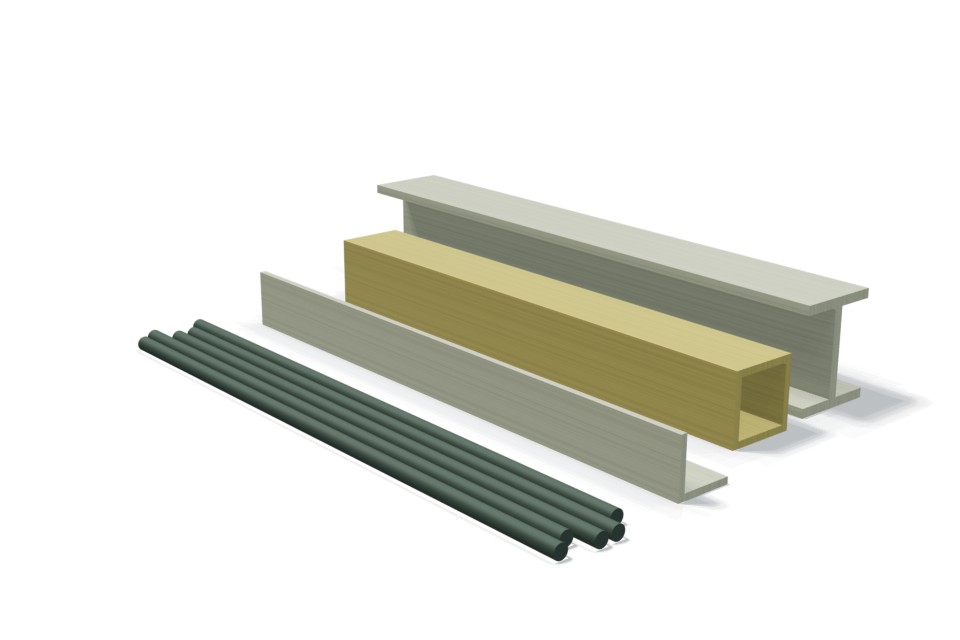
Storage tanks, cladding panels, composite rebar and pultruded profiles for corrosive environments.
Tanks · rebar · profiles
Sectors with longer qualification routes or higher production volumes.
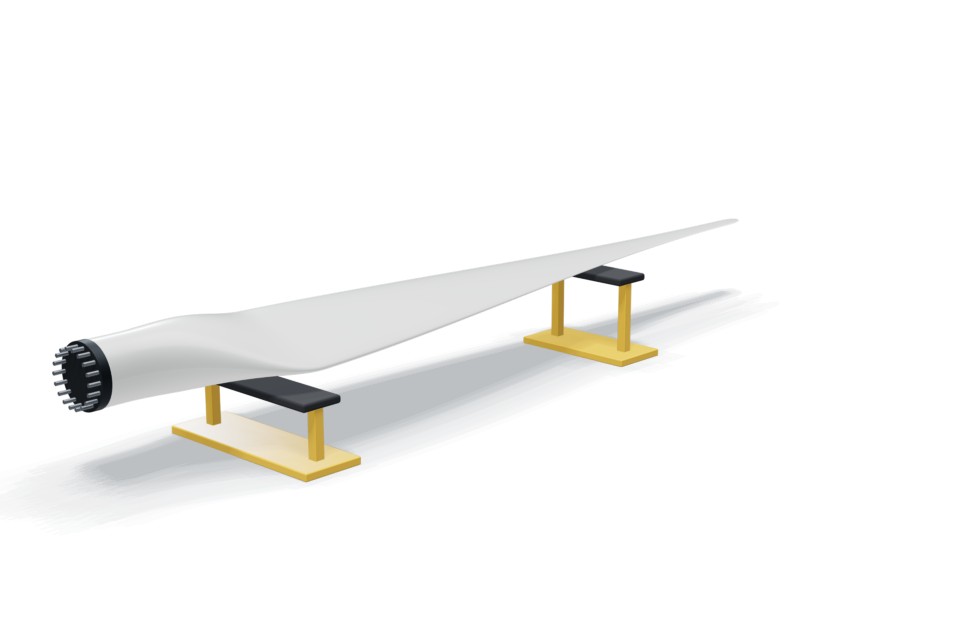
Wind blade shells and spar caps, solar mounting structures and hydrogen storage vessels.
Blades · spar caps · H₂ vessels
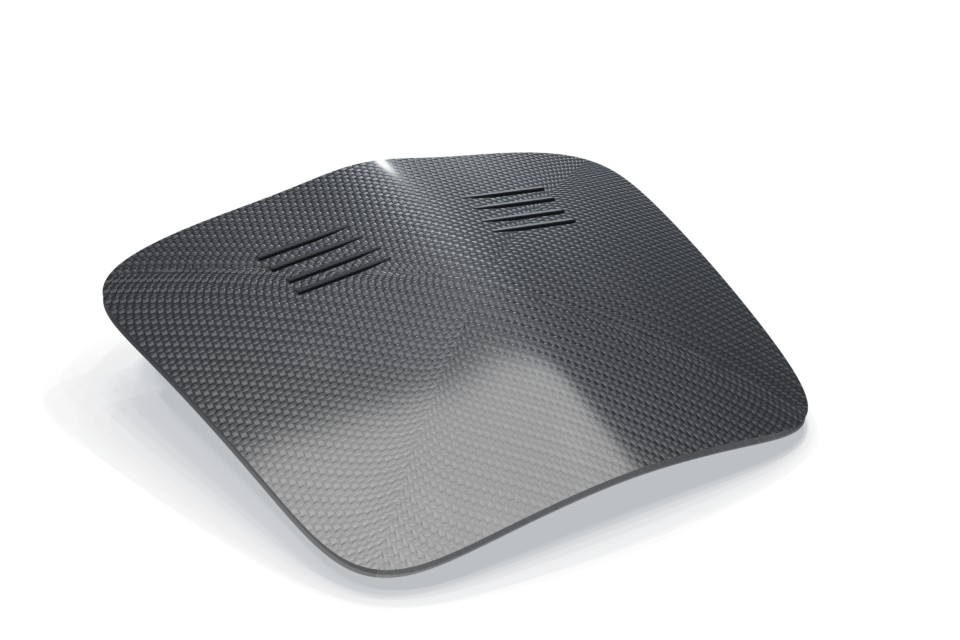
Body and chassis parts, where cycle time decides whether composites suit volume production.
Body · chassis
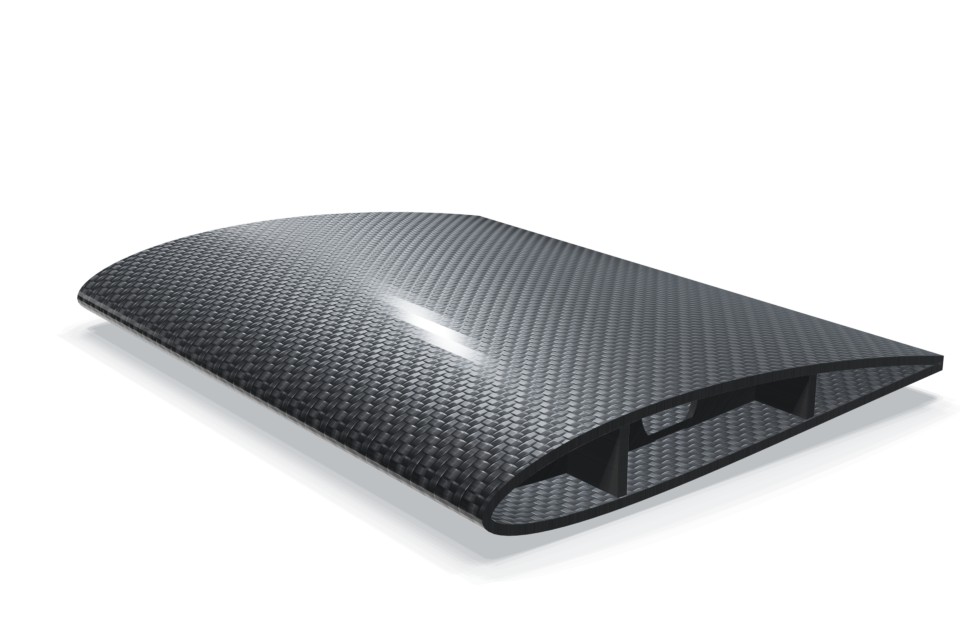
Structural components, once a new cure process is qualified with the manufacturer and its authority.
Structural components
Another part?If it is a thermoset composite, it is worth assessing. Send the geometry and your current cure schedule.
Discuss a partSolutions · with partners
Induction is our own technology. Around it, 4NMx supplies partner systems to build, join, inspect and power non-metallic structures.
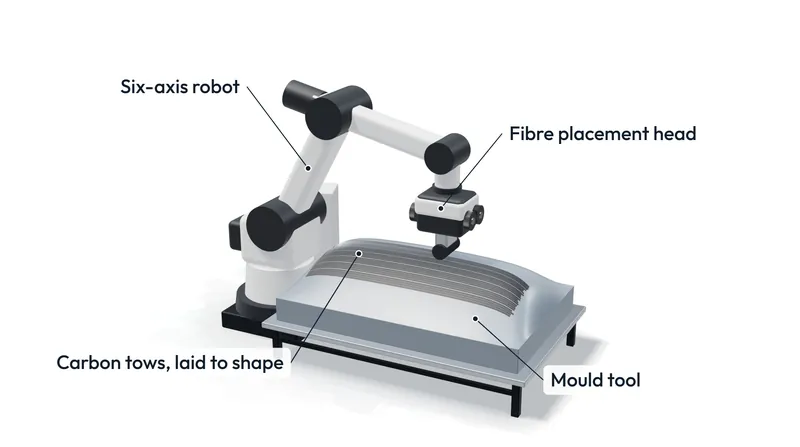 Build · partnerAutomated fibre placementTows laid to shape by robot, ahead of the cure.
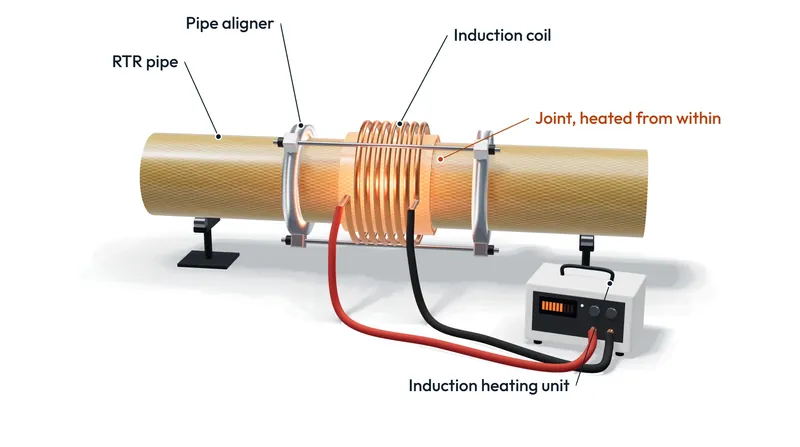 Join · 4NMx technologyInduction joining in the fieldThe curing principle, applied to RTR pipe joints.
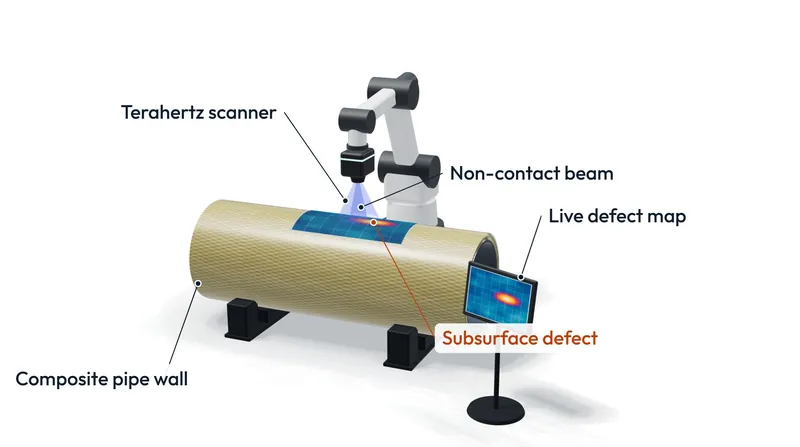 Inspect · partnerNon-contact terahertz NDTSubsurface defects read through composite walls.
Overview figures are illustrative renders, not photographs of 4NMx or partner equipment.
Showing all 8 solutions
Field joints and repairs for composite pipe, cured by induction.
Our patent-pending, closed-loop induction cure as a portable kit. The joint heats from within, so no oven or heating blanket has to reach the pipe.
Status: in development; seeking field pilots.
Development targets against conventionally heat-cured field joints, to be confirmed in field pilots.
See inside the part without touching it.
Terahertz inspection for automated lines. It reads through non-metallic walls and streams results as the part moves.
Status: partner product, supplied through 4NMx. Datasheet on request.
Supplier figures (Innotech Photonics).
Wall thickness in one point-and-click.
A handheld terahertz gauge for GFRP, RTR, RTP and polymer components, in the field or on the plant floor.
Status: partner product, supplied through 4NMx. Datasheet on request.
Supplier figures (Innotech Photonics).
Automated 3D inspection, part by part.
A modular platform that moves a TeraVISUS Pro sensor around the part on three linear axes and a rotary table, mapping wall thickness and structure.
Status: partner product, supplied through 4NMx. Datasheet on request.
Supplier figures (Innotech Photonics).
Multi-tow fibre placement on an industrial robot.
Lays tows to shape by robot, for thermoset, thermoplastic and dry-fibre structures.
Status: partner product, supplied through 4NMx. Configuration is agreed per project.
Manufacturer figures from the Addcomposites AFP-X page, as published in November 2026.
Move hydrogen by road, rail or sea.
A cryogenic ISO tank container for bulk liquid hydrogen, framed for standard intermodal transport.
Status: partner product. Manufacturer and datasheet on enquiry.
Supplier figures, not verified by 4NMx.
Quiet power where there is no grid.
Solid oxide fuel-cell generators for off-grid sites, running on fuels already available at remote assets.
Status: partner product. Manufacturer and datasheet on enquiry.
Supplier figures, not verified by 4NMx.
Hydrogen power from 30 to 200 kW.
Hydrogen fuel-cell modules and complete generators, for mobility, rail, unmanned aircraft and backup power.
Status: partner product. Manufacturer and datasheet on enquiry.
Supplier figures, not verified by 4NMx.
* Hydrogen and fuel-cell products are made by a partner and offered through 4NMx; the manufacturer and datasheets are shared on enquiry. All partner specifications are supplier figures.
Ask about a solutionThe founders
A small founding team covering the three disciplines the system depends on.

Founder & CEO
Leads the technical direction of the curing system and the venture's route to industry.

Co-founder & CTO
Co-inventor of the curing system. Leads electromagnetic design and the adaptive control architecture.

Co-founder & COO
Runs operations and delivery, and the machine learning behind real-time process optimisation.

Dr. Suhail Hyder Vattathurvalappil at Mabrook Gulf Toppers, Saudi Arabia
We speak at industry and research events across the Gulf about where induction curing fits composite production, and where it does not yet.
Invite us to speakQuestions
What manufacturers, researchers and investors ask first.
Thermoset systems (epoxy, polyester and vinyl ester) reinforced with carbon or glass fibre. Suitability for a specific layup and resin is assessed in a pilot.
Yes. Magnetic nanoparticles are dispersed in the resin before layup or infusion; they are what the field couples into. How the loading affects processing and cured properties is characterised for each resin system during a pilot.
Embedded sensors report temperature, field strength and a viscosity signal during the cure. The control model estimates the state of cure and adjusts power and frequency, aiming for a uniform cure across changing thickness and geometry. Each part carries a recorded process trace.
TRL 5, self-assessed on the NASA scale: a working prototype has demonstrated closed-loop adaptive curing in the laboratory. Next is a multi-zone cell on representative parts in an industrial setting. 4NMx is supported by the KFUPM DeepTech Venture Program.
Results so far are on laboratory-scale laminates. Larger parts are the purpose of the multi-zone cell planned for the industrial pilot; we do not quote a size limit ahead of it.
Induction replaces the heat source, not consolidation pressure. Consolidation comes from vacuum bagging or tooling, as in other out-of-autoclave routes. Parts that depend on autoclave pressure for void content are assessed case by case.
No. The technology is at laboratory stage and holds no certification or qualification. For regulated parts, qualification rests with the manufacturer and its authority; pilot data is intended to support that work, not replace it.
That is the design intent. The system is modular and needs no pressure vessel, so it is meant to complement or replace oven capacity in an existing workflow. Integration depends on part size, geometry and takt time, worked through during pilot scoping.
Energy goes into the resin rather than air, tooling and a steel chamber, and a shorter cycle leaves less time for losses. Up to 90% is modelled against equivalent autoclave cycles, to be confirmed with measured pilot data.
A scoping conversation about your part family, resin and current cycle, then laboratory trials on your material. You receive cured samples, the process data for each cycle, a comparison with your current schedule, and a plain statement of fit.
Manufacturers with a real curing bottleneck, research partners in materials and process control, and investors backing deep technology at this stage.
Get in touch
A curing bottleneck, a partner product, research, investment or a talk. Choose a reason and it reaches the right person.